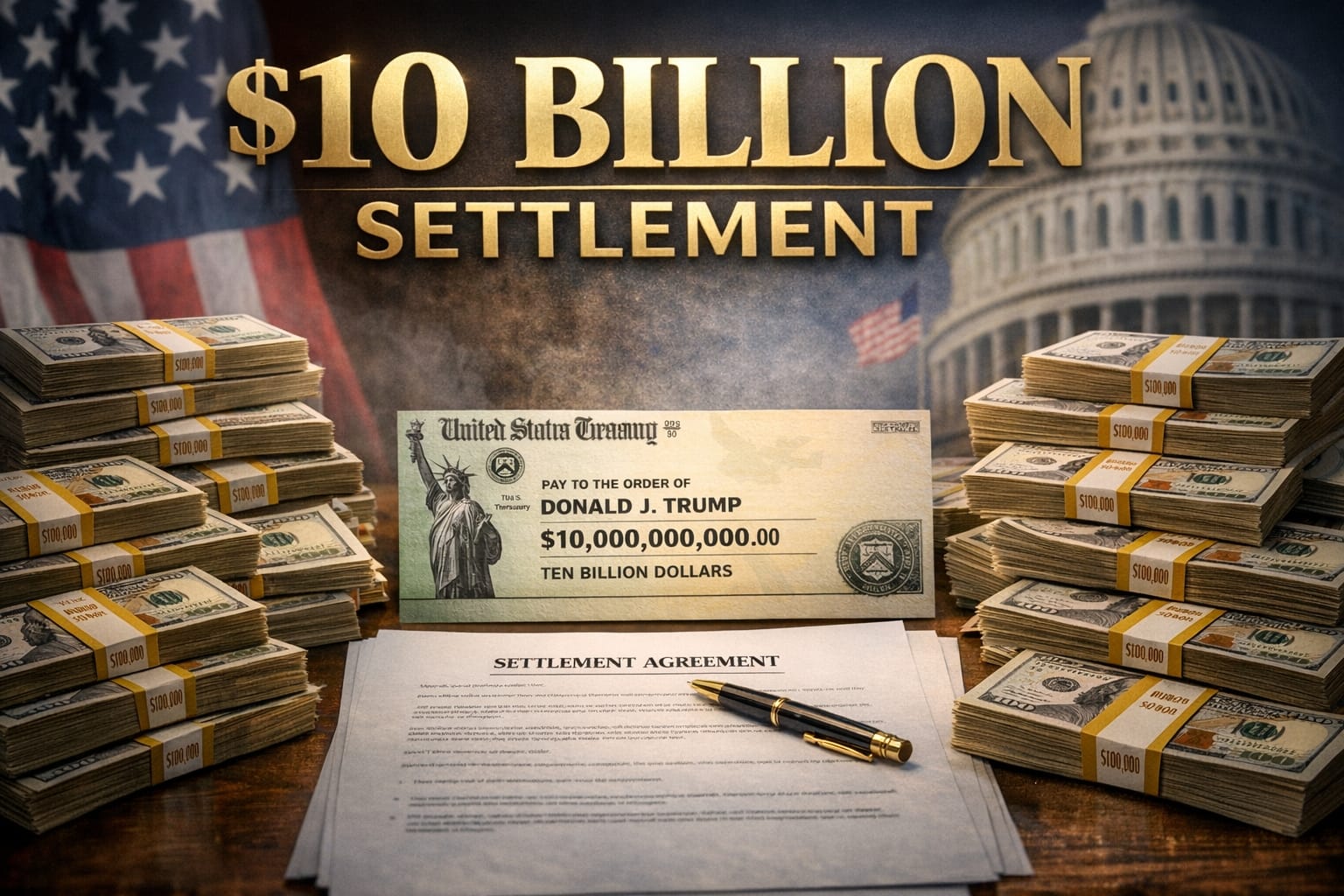
In a moment that many Americans never imagined possible, the federal government agreed to a $10 billion settlement with President Donald Trump—a decision that has left millions stunned, angry, and asking how such an extraordinary outcome could unfold without a single institution standing in the way. For critics, this was not just a legal maneuver; it was a national humiliation, a sign that the guardrails of democracy have eroded to the point of collapse.
To them, the message was unmistakable: the president just walked away with $10 billion of public money, and the country barely blinked.
A System That Didn’t Fight Back
What alarms many observers is not only the size of the settlement, but the silence that followed it. No mass protests. No congressional revolt. No judicial pushback. No bipartisan outrage. The institutions that were designed to check executive power appeared to fold without resistance.
For those who see this as corruption, the question becomes unavoidable: How much more can a democracy endure when its own systems refuse to defend it?
A Dangerous Precedent
Legal scholars quoted in various analyses have warned that when a government pays out massive sums to its own leader—especially under circumstances lacking transparency—it sets a precedent that future administrations could exploit. Critics argue that it blurs the line between public office and personal enrichment, a line that democratic societies depend on to maintain legitimacy.
Some commentators have described the settlement as “a transfer of wealth from taxpayers to the president,” while others have called it “a collapse of institutional courage.” Regardless of the phrasing, the sentiment is the same: this was a moment when the country needed accountability, and instead it got silence.
Where Was the Resistance?
The absence of pushback has become its own scandal. People are asking:
- Where was Congress?
- Where were the watchdogs?
- Where were the voices that normally rise in moments of national crisis?
For many, the lack of resistance is more frightening than the settlement itself. It suggests a political environment where fear, loyalty, or exhaustion has replaced oversight. It suggests a public so overwhelmed by years of political turmoil that even a $10 billion payout barely registers.
A Nation at a Crossroads
Whether one sees this settlement as corruption, incompetence, or something else entirely, the implications are profound. A democracy cannot function when its institutions fail to act. It cannot survive when accountability becomes optional. And it cannot thrive when public money becomes a bargaining chip in political negotiations.
For those who believe the settlement represents a historic breach of trust, the question is no longer “How did this happen?” but “What happens next?”
Because if a government can hand over $10 billion to its own leader without resistance, then the country is standing at a crossroads — and the path it chooses will define its future.
