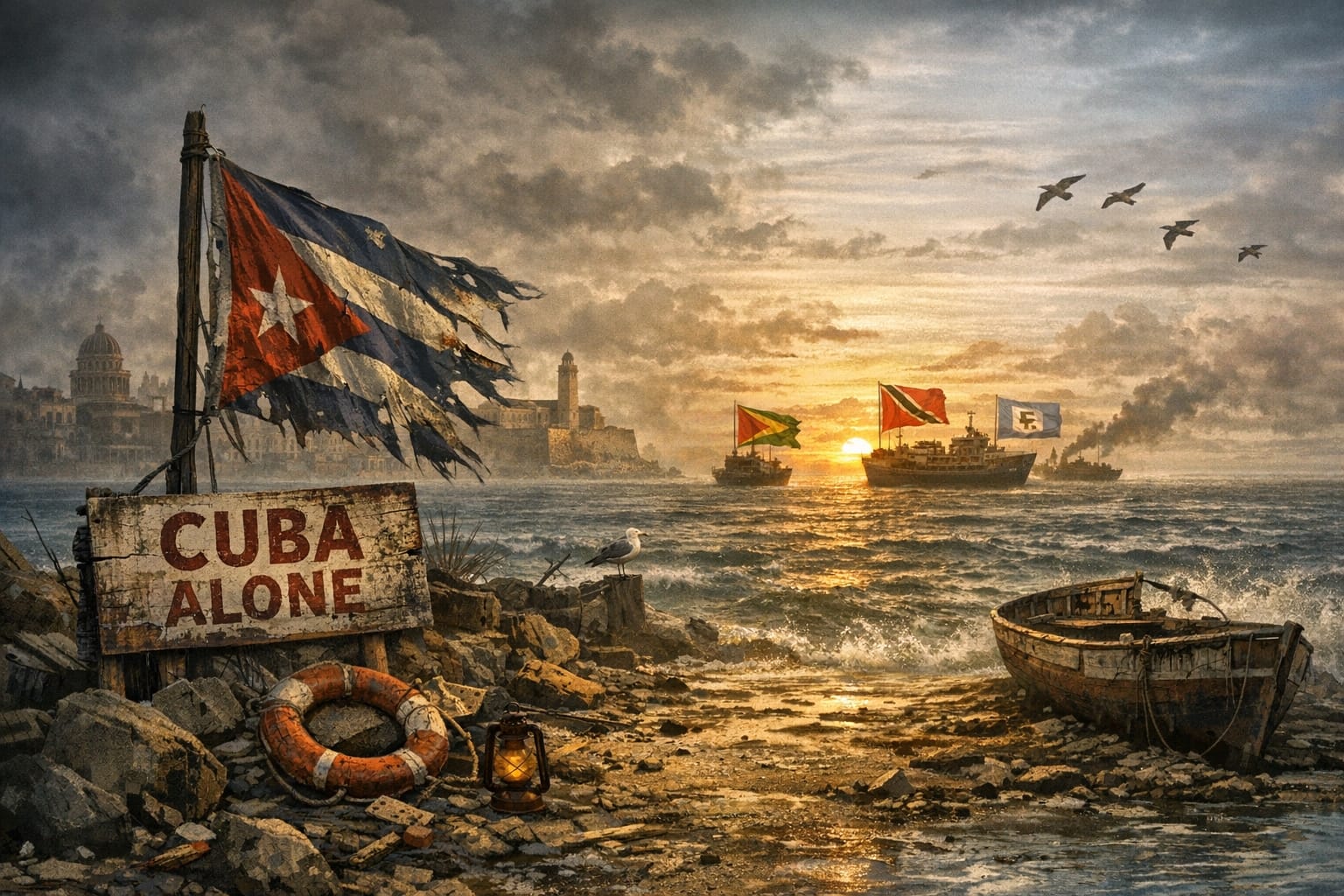
When the Prime Minister of Trinidad and Tobago and the President of Guyana met with the President of the United States, the headlines framed it as “regional diplomacy.” But many across the Caribbean are asking a deeper question: diplomacy for whom? And at what cost to Caribbean unity, sovereignty, and long‑standing principles.
Because before flying to Washington, did these leaders sit with Cuba—the Caribbean nation most under pressure, most isolated, and most vulnerable to U.S. hostility? Did they consult the one country whose fate could reshape the entire region?
For many Caribbean people, the answer feels like a painful no.
CARICOM Was Built on Collective Strength—Not Selective Engagement
CARICOM was never meant to be a club of convenience. It was designed as a shield—small nations standing together so none could be picked off or pressured alone.
Historically, that meant:
- Coordinated foreign policy
- Mutual defense of sovereignty
- Solidarity with Cuba, especially when the U.S. tightened its grip
- A commitment to non‑alignment and regional independence
So when two major CARICOM leaders meet the U.S. president without first building a unified Caribbean position—including Cuba—many see it as a break from the region’s founding principles.
Cuba Has Stood With the Caribbean for Decades
Whether one agrees with Cuba’s internal politics or not, the Caribbean knows the truth of its contributions:
- Thousands of doctors sent across the region
- Medical scholarships for Caribbean students
- Disaster relief after hurricanes
- Technical support in health, sports, and education
Cuba has been a consistent partner—even when it had little to give.
Yet today, as Cuba faces severe shortages, economic strangulation, and the threat of deeper confrontation with the United States, CARICOM’s response has been muted.
A Meeting With Washington While Cuba Faces Pressure Sends a Message
To many Caribbean observers, the optics are troubling:
- The U.S. issues travel advisories against Caribbean states
- The U.S. suspends immigrant visas for Caribbean nationals
- The U.S. pressures the region on migration and security
- The U.S. maintains a decades‑long embargo on Cuba
And yet, CARICOM leaders rush to Washington without first strengthening ties with Havana.
Some see this as a strategic misstep. Others call it a sellout that risks dividing CARICOM into “insiders” and “outsiders,” “favored” and “ignored,” “aligned” and “isolated.”
What Caribbean People Are Asking
Across the region, citizens are raising questions:
- Why wasn’t Cuba consulted before meeting the U.S.?
- Why is CARICOM silent while Cuba faces escalating pressure?
- Why do Caribbean leaders accept U.S. demands but not defend regional partners?
- Why meet the U.S. president before building a unified CARICOM position?
These questions aren’t anti‑American—they are pro‑Caribbean.
A Region Cannot Claim Unity While Leaving One Member Exposed
Cuba is not a formal CARICOM member, but it has been a pillar of Caribbean cooperation for decades. To ignore Cuba at a moment of crisis is to weaken the moral foundation of the region.
If CARICOM leaders want to preserve unity, they must:
- Engage Cuba directly
- Build a collective regional stance
- Resist divide‑and‑rule diplomacy
- Defend the principle of non‑interference
- Ensure no Caribbean nation stands alone under pressure
The Caribbean Deserves Leadership Rooted in Courage, Not Fear
Some believe Caribbean leaders are intimidated by the “big power up north.” Others argue they are trying to avoid confrontation. But the region has faced powerful nations before—and survived by standing together.
If the Caribbean wants to avoid fragmentation, it must return to its core values:
- Solidarity
- Sovereignty
- Mutual respect
- Collective action
Because unity is not built in Washington. It is built in the Caribbean—among Caribbean nations—starting with those who need support the most.
