A Critical Investigative Report on the U.S. Strike on Venezuela and the Capture of Nicolás Maduro
By TL Neckles — Investigative Analysis
I. A Strike Announced Before Dawn
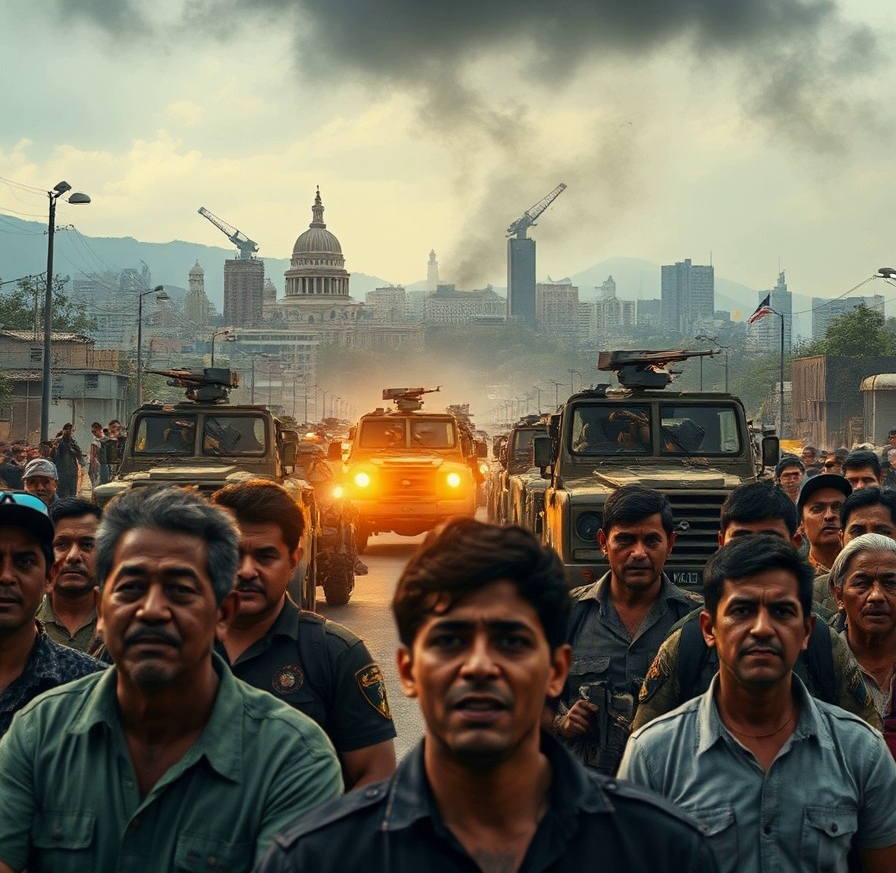
At 4:30 a.m. on January 3, 2026, President Donald Trump announced that the United States had “successfully carried out a large‑scale strike against Venezuela” and had captured Venezuelan President Nicolás Maduro and his wife, Cilia Flores. Hours earlier, explosions had rocked Caracas, with witnesses reporting low‑flying jets, burning vehicles, and plumes of smoke rising over military installations.
The operation was executed by Delta Force, the U.S. Army’s elite counterterrorism unit, which raided Maduro’s residence and seized the couple before transporting them to a U.S. warship in the Caribbean.
The U.S. government later confirmed that Maduro was being flown to New York to face charges including narco‑terrorism conspiracy, cocaine importation conspiracy, and illegal weapons offenses.
This was not just a military strike.
It was the forcible removal of a sitting head of state — an act that has not occurred in the Western Hemisphere since the 1989 seizure of Panama’s Manuel Noriega.
II. A President Declared Illegitimate — and Treated as a Criminal
For years, the U.S. government had accused Maduro of running a criminal narco‑state. Trump called him an “illegitimate dictator” and “kingpin of a vast criminal network” responsible for trafficking drugs into the United States.
The Justice Department unsealed a new indictment the morning of the strike, alleging that Maduro led a “corrupt, illegitimate government” that protected drug trafficking operations and enriched military elites.
But the timing of the strike — just months after the widely condemned 2024 Venezuelan election — raises deeper questions. International observers and opposition groups had declared the election fraudulent, and the U.S. refused to recognize Maduro’s third term.
The military operation, then, was not only about criminal charges.
It was about political legitimacy — and who gets to define it.
III. “We’re Going to Run the Country”
In a statement that stunned diplomats worldwide, Trump declared that the United States would “run” Venezuela temporarily to ensure a “proper and judicious transition”.
This was not a slip of the tongue.
It was a policy.
Trump said the U.S. would be “very strongly involved” in Venezuela’s oil industry — the largest proven reserves in the world — and that American companies would invest “billions” to rebuild it.
Critics immediately warned that the operation blurred the line between counterterrorism and resource extraction.
The Venezuelan government, now fractured and leaderless, accused the U.S. of attempting to “seize Venezuela’s strategic resources, particularly its oil and minerals”.
IV. A Region in Shock — and a World on Edge
The international reaction was swift and severe.
- The United Nations said it was “deeply alarmed,” warning that the strike and detention of a sitting president constituted a “dangerous precedent” and may violate international law.
- China condemned the operation as a “hegemonic act” and expressed “deep shock”.
- U.S. lawmakers were sharply divided:
- Some Republicans praised the strike as necessary to remove an “illegitimate” leader.
- Democrats questioned Trump’s legal authority and warned that he had bypassed Congress.
The legality of the operation remains unclear.
The White House has not disclosed whether Congress was consulted, and the administration has not cited any explicit statutory authorization for the strike.
V. A Country in Darkness
Inside Venezuela, the consequences were immediate and devastating.
- Explosions damaged military bases and infrastructure across Caracas.
- Parts of the capital lost electricity after the strikes.
- The government declared a national emergency and called for “armed struggle” against what it called “imperialist aggression”.
- Civilians fled neighborhoods near military targets, fearing further attacks.
The Venezuelan state — already weakened by years of economic collapse — now faces fragmentation.
Loyalist militias, opposition groups, and military factions are all vying for control.
The U.S. insists the operation will stabilize the country.
History suggests otherwise.
VI. The Pattern Behind the Crisis
Maduro’s downfall cannot be separated from his long record of election denial, repression, and authoritarian consolidation:
- His 2024 reelection was widely condemned as fraudulent.
- His government oversaw economic collapse, hyperinflation, and mass emigration.
- He jailed opponents, cracked down on protests, and dismantled democratic institutions.
But the U.S. response — a unilateral military strike and the capture of a foreign head of state — raises its own set of dangers.
If powerful nations can remove leaders by force,
what happens to the international order?
Who decides which governments are legitimate?
And what prevents this precedent from being used elsewhere?
VII. “We Are Back to Night Overcoming Right”
Venezuela has been plunged into a new darkness:
- A president who refused to accept electoral defeat.
- A foreign power that removed him by force.
- A nation caught between authoritarianism and interventionism.
- A hemisphere forced to confront the collapse of long‑standing norms.
The night has overcome the right —
not just the political right or left,
but the right of nations to self‑determination,
the right of people to choose their leaders,
and the right of international law to restrain power.
What comes next is uncertain.
But the world has crossed a threshold that cannot be uncrossed.
